Abstract
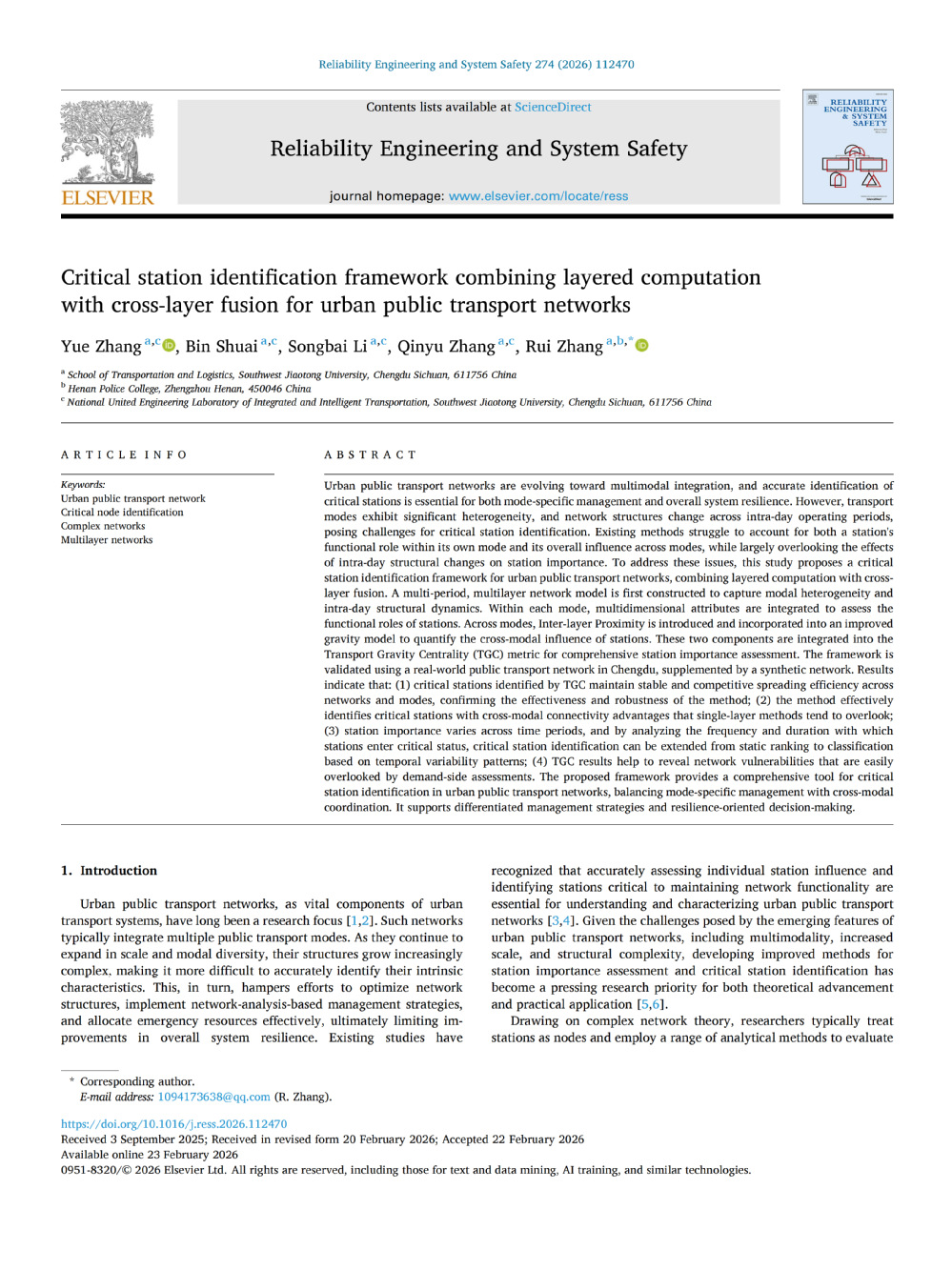
Urban public transport networks are evolving toward multimodal integration, and accurate identification of critical stations is essential for both mode-specific management and overall system resilience. However, transport modes exhibit significant heterogeneity, and network structures change across intra-day operating periods, posing challenges for critical station identification. Existing methods struggle to account for both a station's functional role within its own mode and its overall influence across modes, while largely overlooking the effects of intra-day structural changes on station importance. To address these issues, this study proposes a critical station identification framework for urban public transport networks, combining layered computation with cross-layer fusion. A multi-period, multilayer network model is first constructed to capture modal heterogeneity and intra-day structural dynamics. Within each mode, multidimensional attributes are integrated to assess the functional roles of stations. Across modes, Inter-layer Proximity is introduced and incorporated into an improved gravity model to quantify the cross-modal influence of stations. These two components are integrated into the Transport Gravity Centrality (TGC) metric for comprehensive station importance assessment. The framework is validated using a real-world public transport network in Chengdu, supplemented by a synthetic network. Results indicate that: (1) critical stations identified by TGC maintain stable and competitive spreading efficiency across networks and modes, confirming the effectiveness and robustness of the method; (2) the method effectively identifies critical stations with cross-modal connectivity advantages that single-layer methods tend to overlook; (3) station importance varies across time periods, and by analyzing the frequency and duration with which stations enter critical status, critical station identification can be extended from static ranking to classification based on temporal variability patterns; (4) TGC results help to reveal network vulnerabilities that are easily overlooked by demand-side assessments. The proposed framework provides a comprehensive tool for critical station identification in urban public transport networks, balancing mode-specific management with cross-modal coordination. It supports differentiated management strategies and resilience-oriented decision-making.
Zhang, Y. , Shuai, B. , Li, S. , Zhang, Q. , Zhang, R. , & Soares, C. G. . (2026). Critical station identification framework combining layered computation with cross-layer fusion for urban public transport networks.